- Home
- Homes
Heating and cooling for houses in Greeley
Furnaces, air conditioning, evaporative coolers, heat pumps and ductwork — checked in the order that costs you least, and replaced only when replacement is actually the answer.
No heat
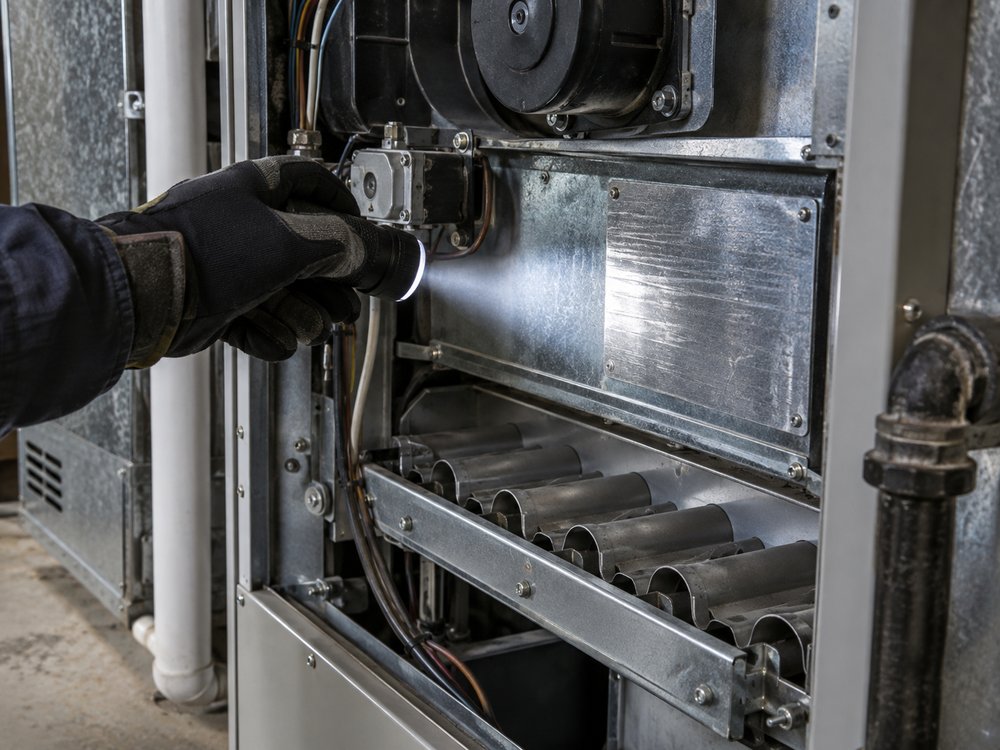
A furnace that will not run is diagnosed from the cheap end. The order below is the order we work in, and it is deliberate: the parts at the top fail most often and cost least.
- 01 · Power
- Breaker, the service switch that looks like a light switch beside the furnace, and the door interlock. A furnace will not run with the panel off the wrong way round.
- 02 · Thermostat
- Batteries, wiring and settings. A surprising number of January call-outs end here, and we say so rather than finding something else.
- 03 · Filter & airflow
- A blocked filter trips the limit switch. The furnace runs, heats, shuts off and locks out. It reads exactly like a failure.
- 04 · Ignition & flame sensing
- Igniter, flame sensor, pressure switch and condensate on a high-efficiency unit. Most genuine faults are here, and most of them are inexpensive.
- 05 · Gas valve & board
- Checked last, because they fail least and cost most. If we get here, you get the reading that proves it before anything is ordered.
- 06 · Heat exchanger
- Inspected on every no-heat call whatever the fault was. A cracked exchanger ends the visit — the appliance is shut off and tagged, and no repair is attempted.
Carbon monoxide and gas
If a carbon monoxide alarm is sounding, or you can smell gas, do not ring us first. Get everybody outside and call 911 and your gas utility’s emergency number from outside the building. They come faster than any contractor, they do not charge you for a false alarm, and they will make the property safe.
Ring us afterwards. Finding out why it happened, and putting it right, is our job. Making the building safe in the next ten minutes is theirs.
The two things Greeley adds
Altitude and dry air. Both change what the right answer is, and both are routinely ignored.
The plate rating is a sea-level number
At roughly 4,660 ft there is less oxygen per cubic foot of air, so a gas appliance does not produce what its plate says. Manufacturers deal with this differently — some require a high-altitude orifice kit above a stated elevation, some specify a manifold pressure change, some certify the appliance across a range with no change at all.
Which of those applies is a model-by-model question, and it is in the installation instructions for that unit. We check it against the model number on the plate rather than assuming. A unit set up for sea level and left that way here will not be running as its designer intended.
An evaporative cooler is not an inferior air conditioner
In a dry climate it is a different machine doing a different job, and in many Greeley houses it is the appropriate one. It uses far less electricity and it brings in outdoor air, which is why it wants a window or a relief opening left open — the commonest complaint about them is a house that gets muggy, and the commonest cause is that the relief path was closed up.
Where it genuinely does not cope — a humid spell, a house with no relief path, a room that has to hold a set temperature — we will say so and price refrigerated cooling. We will not tell you the cooler is obsolete, because here it is not.
A room that never keeps up
The commonest request we get, and the one most often answered with the wrong equipment.
- What it usually is
- Airflow. A branch added during a remodel, a crushed flexible run in a crawlspace, a damper closed years ago, or a return duct far too small for the rooms it serves.
- How it gets settled
- We measure static pressure across the system and airflow at that register and at a register that works. That turns an argument into two numbers on a page.
- Duct leakage
- Ducts running through an unconditioned attic or crawlspace lose air before it reaches the room. Sealing them is cheaper than any equipment and it fixes both seasons at once.
- When bigger is right
- Occasionally it is — a genuine addition, a converted garage, a finished basement that was never in the original design. Then it is a heat loss calculation, not a guess.
- What we will not do
- Sell a larger furnace to fix a duct. An oversized furnace short-cycles, heats unevenly and makes the cold room slightly worse, not better.
Replacing something
- Heat loss
- Room by room, from the actual construction, glazing and insulation. Not from floor area and not from the old unit’s rating.
- The existing ducts
- Measured. If the duct system cannot carry the air the new equipment needs, a better furnace makes the house worse. That is written into the quote either way.
- The flue
- Changing from an older furnace to a high-efficiency one changes the venting entirely, and on a shared flue it can affect the water heater as well. This is part of the quote, not a surprise on the day.
- The electrical supply
- Read off the plate of the proposed unit — minimum circuit ampacity and maximum overcurrent protection — and compared with what is actually there.
- What you get
- Model numbers, capacities, what is being removed, what is being altered, and the price. One page, in plain words.